




It's 2:00 AM, the room is dead quiet, your body is exhausted, but your brain is running a full marathon. Instead of sleeping you're deep in a TikTok rabbit hole when that video pops up with the robotic voice:
"If you're seeing this on your For You Page right now, it means you need to put your phone down and go to bed."
First of all, personal attack. Second of all, they aren't wrong.
When you're serious about performing at your best, sleep isn't a luxury. It's the recovery mechanism everything else depends on. And it's almost always the first thing to break down.
Rolling over and trying harder isn't going to fix it. You need to understand why your brain won't shut off in the first place.
3 Reasons Your Brain Refuses to Wind Down
Struggling to fall asleep is rarely random. It's usually your biology getting the wrong signals entirely.
1. The Blue Light Problem
Your circadian rhythm is regulated by light.
Morning sunlight hits your eyes, melatonin stops, cortisol spikes, and you wake up.
Your phone screen mimics that exact signal. Scrolling in bed at night tells your brain it's noon, which aggressively blocks the melatonin your body is trying to release.
2. Broken Sleep Associations
Your bedroom should be reserved for rest.
When you answer work messages from your pillow or watch high-stimulation content in bed, you build a psychological link between your sleeping space and mental alertness. Your brain stops treating the bed as a cue to wind down.
3. Elevated Nighttime Cortisol
If you're pushing hard during the day, your stress hormones don't automatically switch off when you lie down.
Without an intentional signal that the day is over, cortisol keeps your nervous system in a state of low-level vigilance. Deep, restorative sleep becomes nearly impossible.
The Evening Protocol
Put the phone away at least 60 minutes before bed and pick up a book or a journal instead. The algorithm will survive without you.
Your core body temperature needs to drop a couple of degrees to initiate deep sleep so keep your bedroom between 60 and 67°F and block out ambient light.
Build a consistent wind down ritual, maybe a hot shower, a stretching routine, or simply dimming the lights at the same time each night gives your nervous system a clear signal that it's safe to downshift.
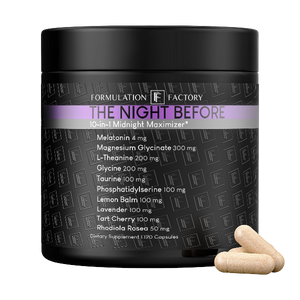
Advanced Support: The Night Before from Formulation Factory
Good habits form the foundation but if your biochemistry is still running hot after a demanding day, you often need more direct support to bridge the gap between high-output performance and actual deep recovery.
The Night Before is a formula built across three pillars: deepening sleep and recovery, lowering cortisol and anxiety, and quieting the mental chatter that keeps you staring at the ceiling.
Every ingredient is on the label at a full, effective dose, no proprietary blends, no fairy dust.
The current formula includes 4mg of Melatonin to support sleep onset and circadian rhythm, paired with Magnesium Glycinate, L-Theanine, Glycine, and six other researched ingredients that work on the full sleep system rather than just knocking you out.
For those who prefer to avoid melatonin entirely, a melatonin-free version of The Night Before is launching soon.
Either way, the goal is the same: you wake up clear, not groggy because a good day starts the night before.
Now close the tab, put the phone on the charger across the room, and get some rest.